Jalwa Game Colour Trading: How Number and Colour Mapping Works
Understand Jalwa Game colour trading number mapping, how numbers connect to colour results, how to read charts, and why mapping rules matter.
In this article
- Jalwa Game Colour Trading: How Number and Colour Mapping Works
- What Is Number and Colour Mapping?
- How Does Colour Prediction Number Mapping Work?
- 1. A Numerical Result Is Recorded
- 2. The Mapping Rules Are Applied
- 3. A Colour Label Is Displayed
- 4. The Result Appears in History
- Understanding a Jalwa Game Colour Number Chart
- Why Isn't There a Universal Number Chart?
- Can One Number Have More Than One Colour?
- Number Results vs Colour Results: What Is the Difference?
- How to Read Number Mapping Without Confusion
- Check the Relevant Game Mode
- Identify the Original Number
- Check the Mapping Definition
- Look for Additional Classifications
- Compare the Correct Round
- Does Number Mapping Affect Probability?
- Common Number Mapping Mistakes
- India-Specific Safety and Legal Considerations
- Frequently Asked Questions
- What is Jalwa Game colour trading number mapping?
- Is there an official Jalwa Game number colour chart?
- Do all colour prediction apps use the same mapping?
- Can one number represent two colours?
- Are numbers from 0 to 9 always used?
- Can number mapping predict the next colour?
- Why does a colour result sometimes look incorrect?
- Conclusion
Jalwa Game Colour Trading: How Number and Colour Mapping Works
When exploring Jalwa Game colour trading, you may notice numbers appearing alongside red, green, or violet indicators. These visual elements can make the interface look straightforward, but understanding how they relate requires more than recognising three colours.
The key concept is number-to-colour mapping, which describes how a numerical result is assigned one or more colour labels according to predefined rules.
This guide explains Jalwa Game colour trading number mapping, how to interpret a number chart, and what to check when a displayed result seems confusing.
Quick Answer: In a number-based colour prediction system, a completed round produces a number that is classified using a mapping table. The corresponding colour indicator is then displayed. Exact mappings depend on the platform and must be verified against its published rules.
What Is Number and Colour Mapping?
Number mapping is a classification system.
Imagine an application displaying digits from 0 to 9. Rather than presenting every result only as a number, the software assigns colour labels to different numerical outcomes.
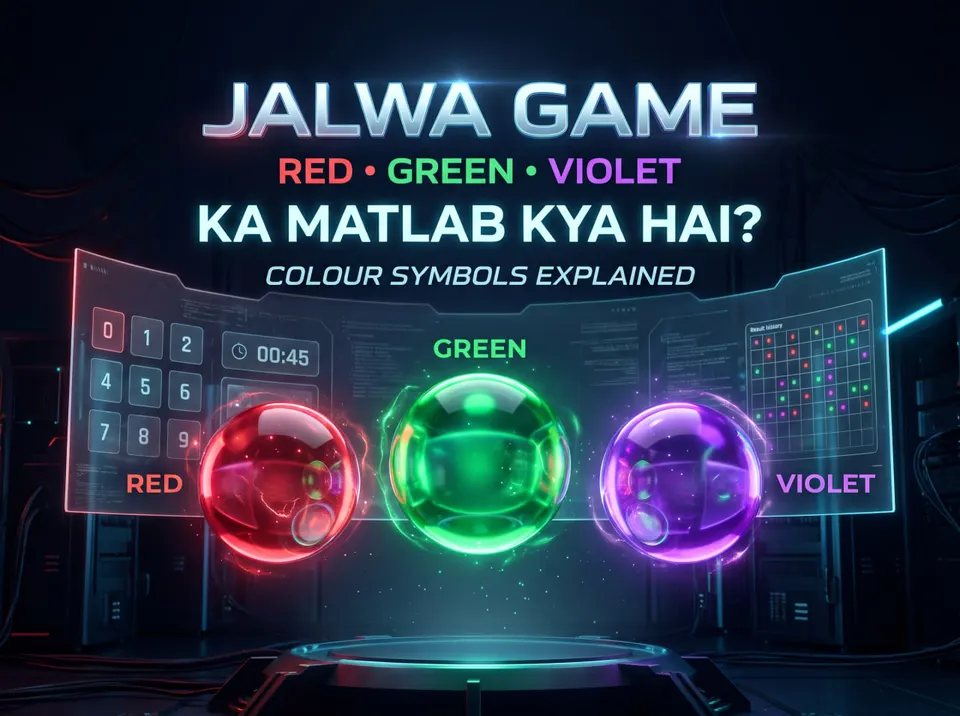
For instance, a hypothetical educational system might classify certain digits as Red, others as Green, and some under an additional Violet category.
The important distinction is that a colour label describes a numerical outcome; it does not create that outcome.
A mapping table defines the relationship between the original number and its visual classification.
However, not every application follows identical rules. A chart from one platform should never automatically be treated as the official mapping for another.
How Does Colour Prediction Number Mapping Work?
A number-based classification system can be understood through four stages.
1. A Numerical Result Is Recorded
A completed round has an associated numerical result.
Some colour prediction formats use digits between 0 and 9, although the exact result range depends on the platform.
2. The Mapping Rules Are Applied
The software checks the numerical result against its defined classification rules.
These rules determine which colour indicator corresponds to that number.
3. A Colour Label Is Displayed
The interface displays the relevant colour symbol.
Depending on the system, this may be a coloured circle, a highlighted tile, or a separate result field.
4. The Result Appears in History
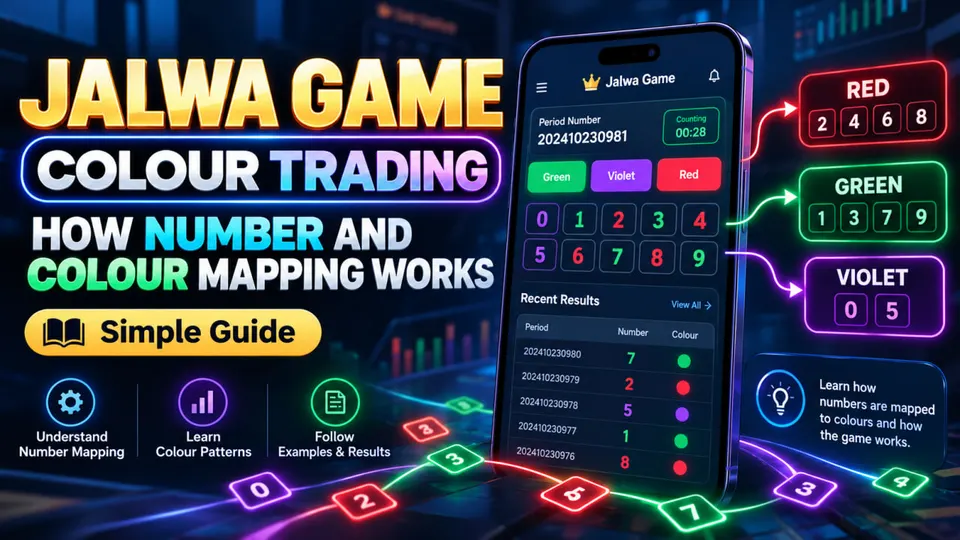
A result history table may display the round identifier, number, and corresponding colour label.
The purpose of mapping is to organise and present results consistently.
It is not evidence that future outcomes can be predicted.
Understanding a Jalwa Game Colour Number Chart
Searches for a jalwa game colour number chart often reflect a simple question: which numbers belong to which colours?
To answer that accurately, you need the specific platform's verified rule table.
A chart should ideally identify the following elements.
| Chart Element | What It Tells You |
|---|---|
| Number | The numerical outcome |
| Colour label | The classification assigned to that number |
| Round ID | The completed round being recorded |
| Game mode | The format or version that produced the result |
| Additional labels | Whether another classification is displayed |
A proper chart should make these relationships clear without requiring users to guess.
Why Isn't There a Universal Number Chart?
Different interfaces can implement different classification rules.
One application may associate a digit with a single colour, while another may display additional labels under special conditions.
This is why copying a mapping chart from an unrelated website can be misleading.
Verification note: This article does not present an official Jalwa Game 0–9 mapping table because an authoritative, current rulebook confirming every number-to-colour assignment was not independently verified.
Can One Number Have More Than One Colour?
Yes, a classification system can technically assign multiple labels to the same numerical outcome.
In mathematics, this is possible whenever categories overlap.
Consider a fictional system containing two categories:
- Category A contains 0, 2, 4, 6, and 8.
- Category B contains 0 and 5.
In that example, the number 0 belongs to both categories.
This illustrates overlapping classifications rather than a contradiction.
The example is not a Jalwa Game rule.
Whether a real colour prediction interface supports overlapping colours must be established through its documented mapping logic.
Number Results vs Colour Results: What Is the Difference?
A number result and a colour result communicate related but different information.
The number identifies the underlying numerical outcome.
The colour represents a classification assigned to that outcome.
For example, an interface may store a number internally and use a coloured indicator to make its category easier to recognise.
This distinction matters when reviewing discrepancies.
If a chart displays an unexpected colour, the problem might involve the mapping rule, selected game mode, or data presentation rather than the numerical result itself.
Without access to verified records, it is not possible to determine which explanation applies to a particular round.
How to Read Number Mapping Without Confusion
When reviewing a Jalwa colour trading result chart, use this interpretation checklist.
Check the Relevant Game Mode
Different modes may use separate round identifiers or result formats.
Ensure the chart belongs to the mode being examined.
Identify the Original Number
Look for the numerical outcome before interpreting its colour.
Check the Mapping Definition
Find the specific rule explaining why that number belongs to the displayed colour category.
Look for Additional Classifications
Some interfaces may show more than one indicator.
Do not assume every additional symbol represents another independently generated result.
Compare the Correct Round
Use the period identifier to avoid comparing a number from one round with a colour from another.
These checks help explain existing records rather than forecast future ones.
Does Number Mapping Affect Probability?
Mapping determines how outcomes are classified, but it does not independently determine how frequently the underlying numbers occur.
Suppose a hypothetical system has ten equally likely numerical outcomes.
If five numbers belong to Category A and five belong to Category B, the two categories would have equal probability under those assumptions.
If a category contains fewer numbers, its probability could differ.
However, that calculation only works when the numerical outcome probabilities and category rules are known.
A visually balanced interface does not prove that all colours have equal chances.
Neither does historical frequency establish the probability of the next round.
Common Number Mapping Mistakes
Several misunderstandings regularly appear in discussions about colour prediction interfaces.
Assuming every platform uses the same chart: Different implementations may use different rules.
Confusing a colour label with a financial result: A colour symbol is not automatically an indication of profit or loss.
Ignoring overlapping categories: A numerical outcome may carry multiple labels if the rules allow it.
Mixing different periods: A number and colour from different rounds cannot be compared as one result.
Treating chart patterns as predictions: Historical classifications do not guarantee future outcomes.
A useful chart should explain what happened, not promise what will happen next.
India-Specific Safety and Legal Considerations
People searching for colour trading information in India should distinguish educational explanations from invitations to participate in real-money gaming.
India's Promotion and Regulation of Online Gaming Act, 2025, and the rules effective from 1 May 2026 prohibit online money games and their promotion.
A numerical mapping chart does not establish that a particular gaming platform is lawful, verified, or safe.
Avoid relying on unverified APK downloads, guaranteed-result services, or unknown groups requesting payments or personal information.
Frequently Asked Questions
What is Jalwa Game colour trading number mapping?
It refers to the process of assigning colour labels to numerical results using predefined classification rules.
Is there an official Jalwa Game number colour chart?
This article could not independently verify a current official chart. Exact mappings should be checked against the relevant platform's authoritative rules.
Do all colour prediction apps use the same mapping?
No. Mapping systems can differ between platforms, versions, and game modes.
Can one number represent two colours?
A classification system can support overlapping labels, but whether a particular game does so depends on its documented rules.
Are numbers from 0 to 9 always used?
Some colour prediction formats use digits from 0 to 9. That range should not be assumed for every platform.
Can number mapping predict the next colour?
No. Mapping explains the classification of outcomes. It does not establish what the next outcome will be.
Why does a colour result sometimes look incorrect?
Possible explanations include comparing different periods, using an unrelated mapping chart, or viewing a different game mode. Specific cases require verified records.
Conclusion
Understanding Jalwa Game colour trading number mapping begins with one principle: numbers are outcomes, while colours are classifications assigned according to rules.
A reliable explanation must identify the result number, relevant mapping definition, game mode, and period information.
Instead of memorising an unverified chart, focus on understanding how classification systems work and why different implementations can produce different displays.
For readers in India, accurate rules, platform verification, and awareness of online gaming restrictions are especially important.
Disclaimer: This article is for educational purposes only. It does not provide betting instructions, guarantee predictions, or endorse any real-money gaming platform.